Well we have our enterprise password Resets that happen every 45 days ; This causes Havoc to my local biztlak server installation.
THIS information Applies if you have NOT backed up your master secret
( Thanks Patrick for pointing out this ) .
if you have in C:\Program Files\Common Files\Enterprise Single Sign-On
>ssoconfig.exe -restoresecret YouBTSSSOBackupfile
So one day you reset that password and suddenly you discover that your biztalk service is not running.
First - Dont Panic !
ok Now you are not panicking :-)
so these are the places you need to reset
Goto ->Start->Run-> Services.msc
and update the password for the following
BizTalk Base EDI service
BiztalkServer Application
Enterprise Single Sign-On Service
MSSQLSERVER
Rule Engine Update Service
SQLSERVERAGENT
Next Open Biztalk Administrator and change passwords for
BizTalk Host Instance Account
BizTalk Isolated Host Instance Account ( In case you set it up same which is not the recommendation btw )
Next Open IIS Manager
Goto ->Start->Run-> inetmgr.msc ->Application pools->Properties ->Identities
and change the password for all the onee below ( You might not have some based on your configuration )
HwsMessagesAppPool
HwsWSAppPool
StsAdminAppPool
STSWebServiceAppPool
TpmWSAppPool (If you are using BAS)
WSSAppPool (Sharepoint app Pool )
BAMAppPool
Whew !! That should get you back on track .
In case it did not leave me a comment or Ping me !
Thursday, January 12, 2006


Tuesday, January 03, 2006
Loading Dynamic Maps in Biztalk Orchestrations
I had a situation in which I had to map into a single schema when messages are send by different parties . Normally this would be done at the recieve port level and document is standardized , but one drawback of this approach is exception handling which is a pain in these situations . It would be great if we can dynamically load a map inside the orchestration and then normalize and we can have or exception handling code written there. I came across and excellent post from Steven Thomas on the same topic .
Inside the expression shape /Message Assignment Shape
objMapType = System.Type.GetType("Map Name ,( Full strong Name of Assembly)");
construct Output_Xml
{
transform (Output_Xml) = objMapType (Input_Xml);
}
Inside the expression shape /Message Assignment Shape
objMapType = System.Type.GetType("Map Name ,( Full strong Name of Assembly)");
construct Output_Xml
{
transform (Output_Xml) = objMapType (Input_Xml);
}
Thursday, December 29, 2005
Error while calling Orchestration Exposed as Webservice
If you are trying to call the Orchestration that are exposed as webservice , You will come acros this error below . This usually happens in Dev machines where Biztalk as well as IIS is on the same machine.
The Messaging Engine failed to register the adapter for "SOAP" for the receive location "/VirtDir/App.asmx". Please verify that the receive location is valid, and that the isolated adapter runs under an account that has access to the BizTalk databases.
An attempt to connect to "BizTalkMgmtDb" SQL Server database on server "Server" failed with error: "Cannot open database requested in login 'BizTalkMgmtDb'. Login fails.".
The "SOAP" adapter is suspending an outbound message going to destination URL
1 ) This issue occurs because the App pool identity that is used by the application pool for the exposed Web service is not added as to the BizTalk Isolated Host Users group. This is needed because the message needs to get properly authenticated to get submitted.
2 ) Also this account needs permission to the %systemroot%\Temp folder on the server that exposes the Web service .This is needed as the web service (.asmx) files are JIT compiled to create DLLs in the %systemroot%\Temp folder.
Giving these correct access and permissions should solve the issue .
The Messaging Engine failed to register the adapter for "SOAP" for the receive location "/VirtDir/App.asmx". Please verify that the receive location is valid, and that the isolated adapter runs under an account that has access to the BizTalk databases.
An attempt to connect to "BizTalkMgmtDb" SQL Server database on server "Server" failed with error: "Cannot open database requested in login 'BizTalkMgmtDb'. Login fails.".
The "SOAP" adapter is suspending an outbound message going to destination URL
1 ) This issue occurs because the App pool identity that is used by the application pool for the exposed Web service is not added as to the BizTalk Isolated Host Users group. This is needed because the message needs to get properly authenticated to get submitted.
2 ) Also this account needs permission to the %systemroot%\Temp folder on the server that exposes the Web service .This is needed as the web service (.asmx) files are JIT compiled to create DLLs in the %systemroot%\Temp folder.
Giving these correct access and permissions should solve the issue .
Friday, November 04, 2005
BTS 2006 MSI Issues
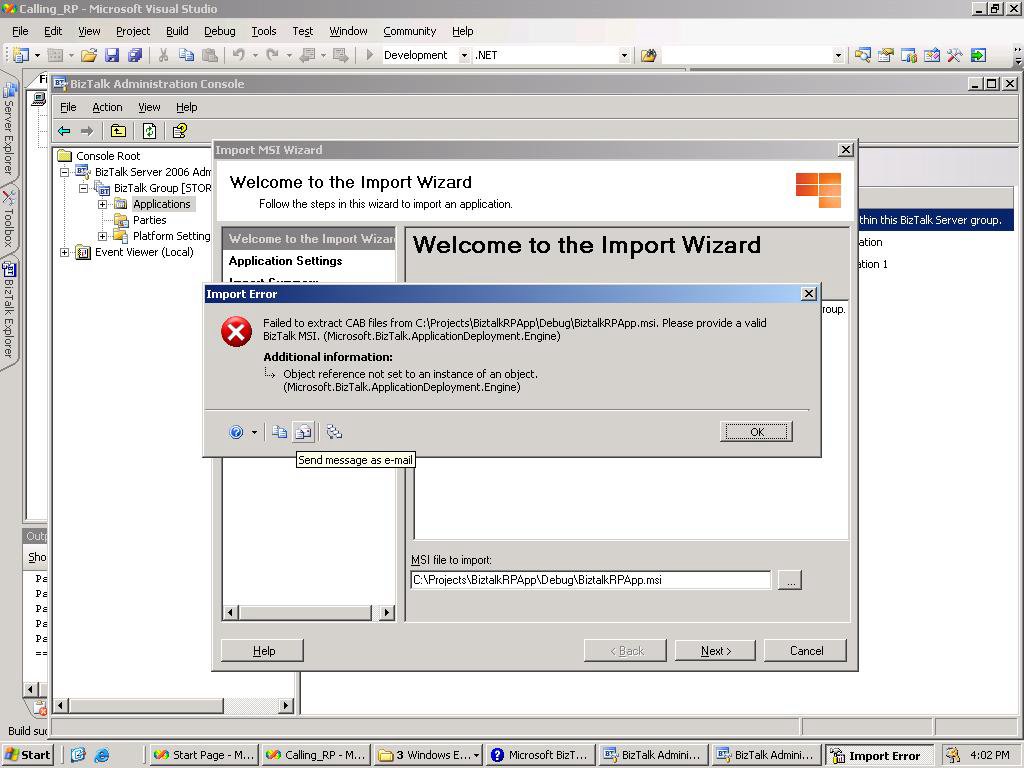
I have built a Biztalk 2006 Project and I added a Setup project and added the output of the Biztalk project, but when I try to import the MSI that I created using the Biztalk administration console. I get an error saying this is not a valid Biztalk MSI ?
Has anybody encountered this error ?
PS : But if I export a already deployed application as an MSI , I am able to import it into anothe BTS2006 VPC machine. So does Biztalk not support the Windows MSI Setup route ?
Calling receive Pipelines from Inside orchestrations BTS2006
I had some Aggregator Orchestration which were running into Zombie situations ,. So when I got the biztalk 2006 beta version I was anxious to try out the new functionality of being able to call your receive pipeline from inside your Orchestration .
You can enumerate through the EnvelopeMessage passed into the recieve pipeline just like you would enumerate in an ICollection or Recordset using .MoveNext()
This is how my built Orchestration looked like
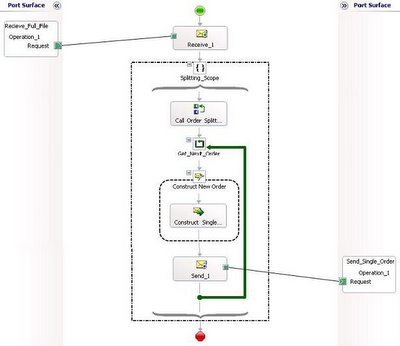
I will briefly try to capture the steps that I took
1.) Create a Document Schema SingleOrder.xsd
2.) Create an Envelope Schema TotalOrder.xsd
3.) Create a receive Pipeline SplitOrder.btp
4.) Add the XML Dissasembler and select the Document and envelope Schemas as above.
5.) Create your Recieve Port and set the document type to your Envelope Schema , This Port now has XMLPassthru transmit , I am calling this message IncomingFullMessage
6.) Now we enter Splitting scope ( Pipelines can only be invoked from Atomic scopes, Also it does not support Recoverable interchange processing when called this way )
7.) Add Microsoft.XLANGs.Pipeline as Reference and then ;declare a variable for the pipeline in my case
OrderSplitter AS "Microsoft.XLANGs.Pipeline.ReceivePipelineOutputMessages"
8) In the expression Shape Call Order Splitter ,
OrderSplitter = Microsoft.XLANGs.Pipeline.XLANGPipelineManager.ExecuteReceivePipeline(typeof(SplitOrderReceivePipeline),IncomingFullMessage);
9) In the loop Get_Next-Order Shape iterate through each message using
OrderSplitter.MoveNext()
10.) Create an Orchestration variable "SingleOrder" of type Document Schema
11.) Create the Single Message you want in the message assignment Shape and set
SingleOrder = new System.Xml.XmlDocument();
OrderSplitter.GetCurrent(SingleOrder);
12) Now you have the single Message that you want to process. You can send it to whatever process you want , In this example I am just sending the message to a Output folder.
You can enumerate through the EnvelopeMessage passed into the recieve pipeline just like you would enumerate in an ICollection or Recordset using .MoveNext()
This is how my built Orchestration looked like
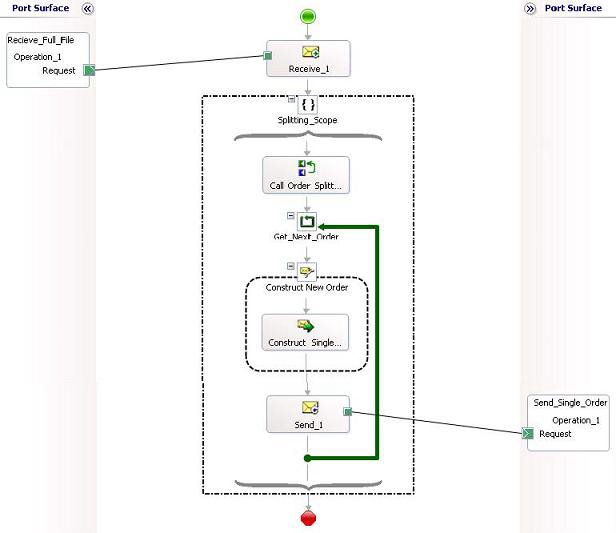
I will briefly try to capture the steps that I took
1.) Create a Document Schema SingleOrder.xsd
2.) Create an Envelope Schema TotalOrder.xsd
3.) Create a receive Pipeline SplitOrder.btp
4.) Add the XML Dissasembler and select the Document and envelope Schemas as above.
5.) Create your Recieve Port and set the document type to your Envelope Schema , This Port now has XMLPassthru transmit , I am calling this message IncomingFullMessage
6.) Now we enter Splitting scope ( Pipelines can only be invoked from Atomic scopes, Also it does not support Recoverable interchange processing when called this way )
7.) Add Microsoft.XLANGs.Pipeline as Reference and then ;declare a variable for the pipeline in my case
OrderSplitter AS "Microsoft.XLANGs.Pipeline.ReceivePipelineOutputMessages"
8) In the expression Shape Call Order Splitter ,
OrderSplitter = Microsoft.XLANGs.Pipeline.XLANGPipelineManager.ExecuteReceivePipeline(typeof(SplitOrderReceivePipeline),IncomingFullMessage);
9) In the loop Get_Next-Order Shape iterate through each message using
OrderSplitter.MoveNext()
10.) Create an Orchestration variable "SingleOrder" of type Document Schema
11.) Create the Single Message you want in the message assignment Shape and set
SingleOrder = new System.Xml.XmlDocument();
OrderSplitter.GetCurrent(SingleOrder);
12) Now you have the single Message that you want to process. You can send it to whatever process you want , In this example I am just sending the message to a Output folder.
Thursday, October 06, 2005
Biztalk Server 2006 Review - Installation
I started this install on a Virtual PC and I was a bit skeptic if I would be able to finish installation that day , Configuring our development server last time required almost 3 days and another instance I remember configuring a machine with two SQL servers with Analysis server on a different machine almost took a week and a call to MS help desk for some gotcha's .So I was a bit skeptic
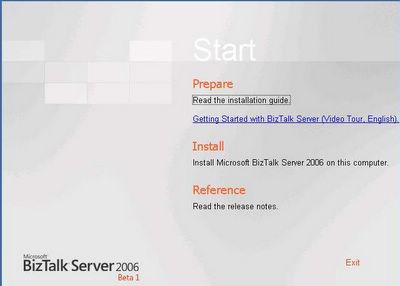
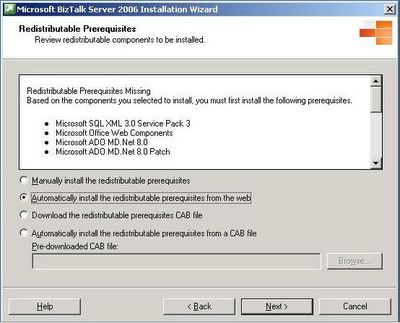
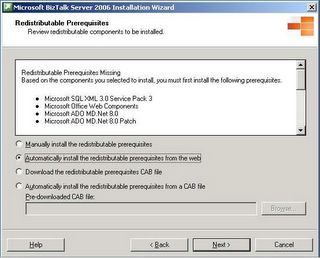
One of the first things that you will notice is that there is a set of ways to download all the pre-requisites. Often times in Biztalk Server 2004 , You will have to go and hunt lot of required files like SQL XML , MSXML 4 and SP1 and office Web Components Update and ... Oh You know what I mean . Now the cool thing in BTS 2006 is that you have an one click option of asking Biztalk to download whatever it wants directly off the web or download ONE Cab file containing everything in case your machine is not on the internet or in my case like a VPC
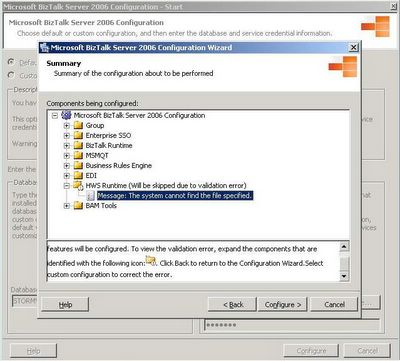
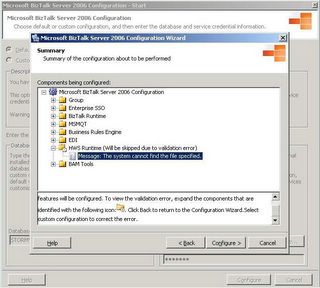
The next thing that one notices is that the whole installation is not one big piece of ALL or NOTHING , wherein some small change or issue would roll back the whole process and you need to go now and manually delete the BizTalk databases at times and that often leads the beginner Biztalk user to give up in frustration .. Also before installation it checks for pre-requisites and tell you what is available and not . Also it asks for one user credentials only if you have a single box scenario. rather than typing the same user name a zillion times
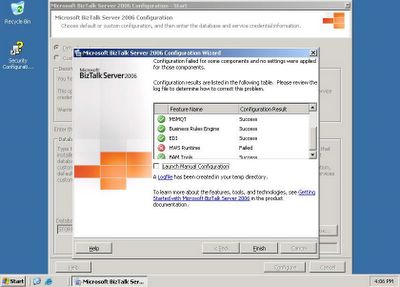
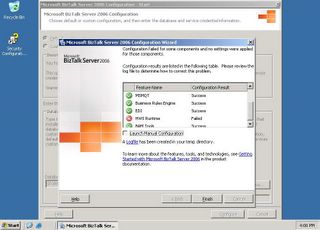
It also shows a smoother progress indication and unlike BTS 2004 , It shows you what is not installed and lets you reconfigure that piece alone later
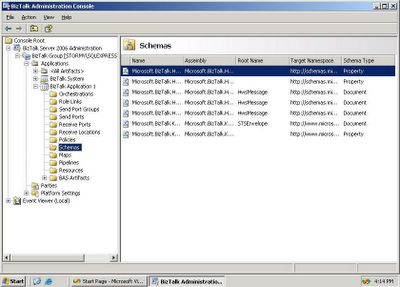
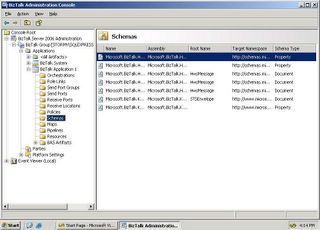
Overall I must say I am impressed with the setup . The biztalk Server Explorer is completely revamped and
now there is a whole concept of artifacts grouped by applications ( Duh !!)
, our administrator's are already looking forward to Biztalk 200^

One of the first things that you will notice is that there is a set of ways to download all the pre-requisites. Often times in Biztalk Server 2004 , You will have to go and hunt lot of required files like SQL XML , MSXML 4 and SP1 and office Web Components Update and ... Oh You know what I mean . Now the cool thing in BTS 2006 is that you have an one click option of asking Biztalk to download whatever it wants directly off the web or download ONE Cab file containing everything in case your machine is not on the internet or in my case like a VPC
The next thing that one notices is that the whole installation is not one big piece of ALL or NOTHING , wherein some small change or issue would roll back the whole process and you need to go now and manually delete the BizTalk databases at times and that often leads the beginner Biztalk user to give up in frustration .. Also before installation it checks for pre-requisites and tell you what is available and not . Also it asks for one user credentials only if you have a single box scenario. rather than typing the same user name a zillion times
It also shows a smoother progress indication and unlike BTS 2004 , It shows you what is not installed and lets you reconfigure that piece alone later
Overall I must say I am impressed with the setup . The biztalk Server Explorer is completely revamped and
now there is a whole concept of artifacts grouped by applications ( Duh !!)
, our administrator's are already looking forward to Biztalk 200^
Monday, August 22, 2005
TO "UNDEPLOY" OR "NOT TO UNDEPLOY"
If you have been working with Biztalk for a considerable amount of time like me
you would have gone through the pains of the Undeploy Regac - Deploy loop , Sometime when you are making changes to Schema , it is quite unavoidable but at lot of time you really don't need to , Just re-gacing your dll and restarting the Biztalk service will do the trick . I have not seen a comprehensive documentation for the same . So the list below is mostly from my own experiences
Schemas
=======
Any changes to Schemas like Namespace , Root Node Name , Promoted properties require a UNDEPLOY - DEPLOY Cycle.
Changing a node which is not a promoted one and not a root node , you can get by with just a GAC and restart
The reason for the same is Your Schema#rootnode is used in subscription evaluation , A changes to this without deploy undeploy will give you an subscription not found error
Maps
====
Changing mapping or Functoids in maps DO NOT require a UNDEPLOY - DEPLOY unless the Schema itself has changed ( See schema Above )
Orchestrations
==============
Changes in Orchestration DO NOT require a UNDEPLOY - DEPLOY Cycle unless Send/receive Port shapes are changed
This is mostly because Schemas would change or you add a new port based on a new schema which needs to get updated in the subscription viewer and this requires undeploy - deploy
Pipelines
=========
Changes in Pipeline DO Require a UNDEPLOY - DEPLOY
Assembly
========
External Assembly change DO NOT require a UNDEPLOY - DEPLOY Cycle unless you change the version number
In VB assembly info if the assembly version is set to 1.1.* it will increment the assembly number for every small change. Though it is good from a certain point of view , it can quickly become a pain if you just want to make a little minor change .
So I suggest you control the version number manually , So you can just re-gac the assembly
Please note Gac-ing the change and restart of the BTSservice is needed for all steps
Last but not the least , you should learn ,try and use BTSNANT tool , It is well worth the effort you spent
you would have gone through the pains of the Undeploy Regac - Deploy loop , Sometime when you are making changes to Schema , it is quite unavoidable but at lot of time you really don't need to , Just re-gacing your dll and restarting the Biztalk service will do the trick . I have not seen a comprehensive documentation for the same . So the list below is mostly from my own experiences
Schemas
=======
Any changes to Schemas like Namespace , Root Node Name , Promoted properties require a UNDEPLOY - DEPLOY Cycle.
Changing a node which is not a promoted one and not a root node , you can get by with just a GAC and restart
The reason for the same is Your Schema#rootnode is used in subscription evaluation , A changes to this without deploy undeploy will give you an subscription not found error
Maps
====
Changing mapping or Functoids in maps DO NOT require a UNDEPLOY - DEPLOY unless the Schema itself has changed ( See schema Above )
Orchestrations
==============
Changes in Orchestration DO NOT require a UNDEPLOY - DEPLOY Cycle unless Send/receive Port shapes are changed
This is mostly because Schemas would change or you add a new port based on a new schema which needs to get updated in the subscription viewer and this requires undeploy - deploy
Pipelines
=========
Changes in Pipeline DO Require a UNDEPLOY - DEPLOY
Assembly
========
External Assembly change DO NOT require a UNDEPLOY - DEPLOY Cycle unless you change the version number
In VB assembly info if the assembly version is set to 1.1.* it will increment the assembly number for every small change. Though it is good from a certain point of view , it can quickly become a pain if you just want to make a little minor change .
So I suggest you control the version number manually , So you can just re-gac the assembly
Please note Gac-ing the change and restart of the BTSservice is needed for all steps
Last but not the least , you should learn ,try and use BTSNANT tool , It is well worth the effort you spent
Wednesday, June 08, 2005
Biztalk FlatFile Disassembler Processing behavior
Recently I had a scenario which involves processing a large amount of flat files; each of whihc went througha Flatfile Dissasembler before the business processing on that started. Here I record some points of interest of FFDASM behaviour. When FlatFile Disassembler is fed with a large amount of files biztalk waits for all files to unpack before it starts processing.
Our test environment had two boxes each both of which configured under the same host and having identical machine config with SQL on a seperate box was used for the test
For our Scenario we had little over 500 files being dropped simultaneously .The file batch size was set at 20 the default.. It was noticed that after picking up the first 20 and initiating disassembling this batch before the next set is picked up , it goes on picks up all the files.( See graph)
Essentially Biztalk seemed to wait for all the messages to get picked up and then flat file disassembler unpacks all of the flat files from the interchange before it starts processing. This is evident from the apparent lack of activity form the time the last file was picked up and when the first set of files started coming out ( See Graph) . I had seen this in one of prior instance and I recently ran some test and got similar results which made me write this post.
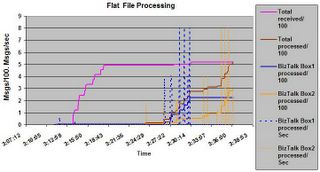
Biztalk Flat File Dissasembler Behaviour
Our test environment had two boxes each both of which configured under the same host and having identical machine config with SQL on a seperate box was used for the test
For our Scenario we had little over 500 files being dropped simultaneously .The file batch size was set at 20 the default.. It was noticed that after picking up the first 20 and initiating disassembling this batch before the next set is picked up , it goes on picks up all the files.( See graph)
Essentially Biztalk seemed to wait for all the messages to get picked up and then flat file disassembler unpacks all of the flat files from the interchange before it starts processing. This is evident from the apparent lack of activity form the time the last file was picked up and when the first set of files started coming out ( See Graph) . I had seen this in one of prior instance and I recently ran some test and got similar results which made me write this post.
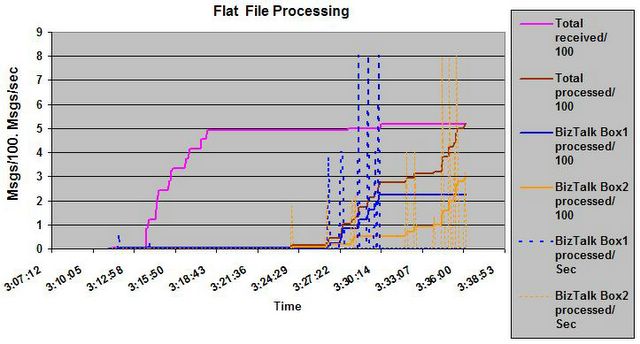
Biztalk Flat File Dissasembler Behaviour
Path Finder , Yukon and Whidbey
After a long wait and amongst lot of confusion on Whidbey not releasing in 2005 , Now it seems all the three VisualStudio 2005 , SQL Server 2005 and Biztalk Server 2006 is all going to come out in the Week of November 7. This was announced at TechED 2005
Also the Community Tech Preview (CTP) editions are out for BTS 2006.
Also the Community Tech Preview (CTP) editions are out for BTS 2006.
Friday, May 20, 2005
Biztalk and File Masks Bug /Feature ?
Recently I was debugging a Biztalk solution with a friend of mine Rajesh ,and we noticed a curious Masking issue with BizTalk
Suppose you give a mask
*.XML
Which of these files are picked up ?
A) Orders.xml
B) Orders.XMLTEST
C) Orders.XML.BAK
D) Orders.TXT
E) ORDERS.XMLINFO
F) ORDERS.XML_BACKUP
I am sure your answer is only A , but in reality Biztalk picks up all files except C and D for a mask *.xml
So instead of looking for a file which starts with * and ending with .xml,It seems Biztalk picks up any file which has wild character starts and has .xml in the name not necessarily ending
But the contradiction to that is if there is one more DOT [.] Case C which is not picked up
So the way the mask gets applied is wild character then matches the last Dot and then matches charecters followwing the dot
Is this an intended behaviour or Bug ?
Suppose you give a mask
*.XML
Which of these files are picked up ?
A) Orders.xml
B) Orders.XMLTEST
C) Orders.XML.BAK
D) Orders.TXT
E) ORDERS.XMLINFO
F) ORDERS.XML_BACKUP
I am sure your answer is only A , but in reality Biztalk picks up all files except C and D for a mask *.xml
So instead of looking for a file which starts with * and ending with .xml,It seems Biztalk picks up any file which has wild character starts and has .xml in the name not necessarily ending
But the contradiction to that is if there is one more DOT [.] Case C which is not picked up
So the way the mask gets applied is wild character then matches the last Dot and then matches charecters followwing the dot
Is this an intended behaviour or Bug ?
Thursday, May 12, 2005
Error Lookup Tool for BizTalk
You can lookup your Biztalk Error codes using this tool ,You can look at this tool from inside VS.NET .
Download it form Got Dot Net here
Once you unzip the tool . You can open up your VStudio->Tools ->ExternalTools and Add this Exe and give a descriptive name like "Biztalk Error Code Lookup"
So next time you get an Error , It is right there
Download it form Got Dot Net here
Once you unzip the tool . You can open up your VStudio->Tools ->ExternalTools and Add this Exe and give a descriptive name like "Biztalk Error Code Lookup"
So next time you get an Error , It is right there
Wednesday, May 11, 2005
Separate Host For Tracking
A recommended Biztalk best practice for performance is to have a separate Tracking Host . So when you add a separate Tracking host , you might encounter this scenario
Event Type: Error
Event Source: BAM EventBus Service
Event Category: None
Event ID: 25
Date: 5/7/2005
Time: 1:53:25 AM
User: N/A
Computer: BiztalkProd1
Description:
Either another TDDS is processing the same data or there is an orphaned session in SQL server holding TDDS lock.EXECUTE permission denied on object 'TDDS_Lock', database 'BizTalkDTADb', owner 'dbo'. SQLServer: mysql, Database: BizTalkDTADb.
Soln: This means that your one of your Hosts other than the Tracking Host has the Host Tracking property Checked . Uncheck this and you should be all set
Event Type: Error
Event Source: BAM EventBus Service
Event Category: None
Event ID: 25
Date: 5/7/2005
Time: 1:53:25 AM
User: N/A
Computer: BiztalkProd1
Description:
Either another TDDS is processing the same data or there is an orphaned session in SQL server holding TDDS lock.EXECUTE permission denied on object 'TDDS_Lock', database 'BizTalkDTADb', owner 'dbo'. SQLServer: mysql, Database: BizTalkDTADb.
Soln: This means that your one of your Hosts other than the Tracking Host has the Host Tracking property Checked . Uncheck this and you should be all set
Friday, May 06, 2005
SEHException While Enlisting Orchestration
I am posting one of the errors we encountered over which considerable time was spent debugging.
You will get the below Error in Event Log
Event Type: Error
Event Source: XLANG/s
Event Category: None
Event ID: 0
Date: 5/5/2005
Time: 3:22:32 PM
User: N/A
Computer: Machine12
Description:
An SEHException exception occurred while the XLANG/s runtime enlisted a service.
Error message:External component has thrown an exception.
Call stack: at Microsoft.BizTalk.MetaDataOM. ICLRType.GetFields(UInt32 dwBindingFlags) at Microsoft.BizTalk.XLANGs.BTXEngine. BTXServiceStaticState._createStringLookup(String svcFullTypeName,
IAssemblyManager asmMgr) at Microsoft.BizTalk. XLANGs.BTXEngine.BTXServiceStaticState. PersistState (String mgmtDBServer, String mgmtDBName, String MsgBoxGroupName, String ApplicationName, String serviceAssembly, String serviceTypeName, Guid[] PortIDs, Guid[] LrpIDs, ITransaction transaction)
at Microsoft.BizTalk.XLANGs. BTXEngine. BTXService.GoLive (String configDBServer, String configDBName, String msgBoxGroupName, String applicationName, String servicePath, String serviceTypeName, Guid[] portIDs, Guid[] lrpIDs, ITransaction transaction)
Exception type: BTXEnlistmentException
Source:
Target Site:
Help Link:
Additional error information:
External component has thrown an exception.
Exception type: SEHException
Source: Microsoft.XLANGs.BizTalk.Engine
Target Site: System.Collections.IEnumerator GetFields(UInt32)
Help Link:
Additional error information:
This normally occurs when you don't have a dependent file of the assembly not in GAC . That is an orchestration which references other Dll's must have the dependencies already GAC'd
Another variation of this enlistment error is OutOfMemory exception which is due to some limitation of WMI , which can be increased with a custom Script
But in our case this was not the case I checked and rechecked the dependencies of our project they were all there .
What we found out was that our Production server did not have Biztalk SP1 applied whereas the dev machine had SP1.
So apparently the issue is still I guess of DLL's Missing in GAC but not of the application but that of Biztalk Later version Assemblies !!
You will get the below Error in Event Log
Event Type: Error
Event Source: XLANG/s
Event Category: None
Event ID: 0
Date: 5/5/2005
Time: 3:22:32 PM
User: N/A
Computer: Machine12
Description:
An SEHException exception occurred while the XLANG/s runtime enlisted a service.
Error message:External component has thrown an exception.
Call stack: at Microsoft.BizTalk.MetaDataOM. ICLRType.GetFields(UInt32 dwBindingFlags) at Microsoft.BizTalk.XLANGs.BTXEngine. BTXServiceStaticState._createStringLookup(String svcFullTypeName,
IAssemblyManager asmMgr) at Microsoft.BizTalk. XLANGs.BTXEngine.BTXServiceStaticState. PersistState (String mgmtDBServer, String mgmtDBName, String MsgBoxGroupName, String ApplicationName, String serviceAssembly, String serviceTypeName, Guid[] PortIDs, Guid[] LrpIDs, ITransaction transaction)
at Microsoft.BizTalk.XLANGs. BTXEngine. BTXService.GoLive (String configDBServer, String configDBName, String msgBoxGroupName, String applicationName, String servicePath, String serviceTypeName, Guid[] portIDs, Guid[] lrpIDs, ITransaction transaction)
Exception type: BTXEnlistmentException
Source:
Target Site:
Help Link:
Additional error information:
External component has thrown an exception.
Exception type: SEHException
Source: Microsoft.XLANGs.BizTalk.Engine
Target Site: System.Collections.IEnumerator GetFields(UInt32)
Help Link:
Additional error information:
This normally occurs when you don't have a dependent file of the assembly not in GAC . That is an orchestration which references other Dll's must have the dependencies already GAC'd
Another variation of this enlistment error is OutOfMemory exception which is due to some limitation of WMI , which can be increased with a custom Script
But in our case this was not the case I checked and rechecked the dependencies of our project they were all there .
What we found out was that our Production server did not have Biztalk SP1 applied whereas the dev machine had SP1.
So apparently the issue is still I guess of DLL's Missing in GAC but not of the application but that of Biztalk Later version Assemblies !!
Friday, April 29, 2005
Biztalk Subscription
I have often been asked What is the big difference between Biztalk 2002 and 2004 , There are a lot to be frank But if I have to pick one , It will be the much better and unified subscribtion mechanism . If you want to learn more about Biztalk subscribtion Charles Young's Blog Post is a good start
Wednesday, April 27, 2005
BizTalk Zombies and more..
You have got this error from biztalk "Completed with discarded messages" and are wondering what that means you could be potentially seeing what in BTS buzz world is called a Zombie . A Zombie is usually a valid message or a response that is left without a subscription to process at that point in time . Though this one liner definition is quite crude explanation . If you are dealing with scenarios like Sequential convoys and batching you are likely to witness this especially when you have large amount of transactions and when your system is operating near to high load conditions ( that is when I have witnessed it the most, though there are scenarios for encountering zombies even under little or No load ) .
If you really want to learn more about Zombies read this Blog from Biztalk Core Engine Team
Now If your solution involves a while loop surrounding a listen with one branch having a receive and the other having a delay shape followed by some expression shape that sets the loop counter and controls the loop termination .You would more than likely see this scenario as delay could be triggered and the message could be delivered after.
Now the condition for delay and time out is we don't want to wait for a message forever . So we timeout after an interval (Tn) but this (Tn) is non-deterministic and is usually set to a small number.
For an app that we had increasing the delay from 10 Secs to 2 minutes( chosen at random)
did away with Zombie occurrences . I would also suggest decreasing the default retry of 5 minutes to a lesser value if you are in a aggregated scenario where you are collecting one message at a time. 2 minute looks like a large interval to wait for one message but keep in mind that this delay is not arithmetic and does not occur for each listen . Most often the message is already there to be consumed and this delay happens ONLY when there is no message to consume. In a stressed Biztalk box our scenario which is an EOD movement had given us a liberty of waiting an extra couple of minutes.
Another solution that works is after the loop is over to have another loop with the same correlation set(following) to drain these instances for a certain amount of time ( DRAINING ). You can do this before or after you send out the final message . in the latter case you can send these drained ones as a second message or log them as errors .
Also a WMI event is generated for a Zombie occurrence , I haven't hit across the details of the same .
If you really want to learn more about Zombies read this Blog from Biztalk Core Engine Team
Now If your solution involves a while loop surrounding a listen with one branch having a receive and the other having a delay shape followed by some expression shape that sets the loop counter and controls the loop termination .You would more than likely see this scenario as delay could be triggered and the message could be delivered after.
Now the condition for delay and time out is we don't want to wait for a message forever . So we timeout after an interval (Tn) but this (Tn) is non-deterministic and is usually set to a small number.
For an app that we had increasing the delay from 10 Secs to 2 minutes( chosen at random)
did away with Zombie occurrences . I would also suggest decreasing the default retry of 5 minutes to a lesser value if you are in a aggregated scenario where you are collecting one message at a time. 2 minute looks like a large interval to wait for one message but keep in mind that this delay is not arithmetic and does not occur for each listen . Most often the message is already there to be consumed and this delay happens ONLY when there is no message to consume. In a stressed Biztalk box our scenario which is an EOD movement had given us a liberty of waiting an extra couple of minutes.
Another solution that works is after the loop is over to have another loop with the same correlation set(following) to drain these instances for a certain amount of time ( DRAINING ). You can do this before or after you send out the final message . in the latter case you can send these drained ones as a second message or log them as errors .
Also a WMI event is generated for a Zombie occurrence , I haven't hit across the details of the same .
Thursday, April 07, 2005
Middleware Mantra - Contract First
When you are designing large middleware integeration efforts , it is quite easy to get into code first integerate later but From classic COM to Biztalk integeration it is always Contract First. Be it an IDL or a Schema . This is generally considered the best way to approch service design. The approach is to design schemas first then generate code from that.
More on Contract First approach ..
http://www.thinktecture.com/
http://www.iona.com/blogs/vinoski
Meanwhile I heard MS is planning to drop support for IDL . Remeber those good old COM days where you could cleanly differntiate the interface from the implementation
Sign the pettition to save IDL here
More on Contract First approach ..
http://www.thinktecture.com/
http://www.iona.com/blogs/vinoski
Meanwhile I heard MS is planning to drop support for IDL . Remeber those good old COM days where you could cleanly differntiate the interface from the implementation
Sign the pettition to save IDL here
Thursday, March 31, 2005
Choosing between Distinguished vs. Promoted Properties
In Biztalk you can promote a property as either distinguished or promoted properties. Choosing what to use is tricky
Distinguished fields
In general use Distinguished fields if you want to just use them in Orchestration
Summary
- No restriction on field length
- No participation in Routing
- No seperate property Schema
- Not accesible by std pipeline components
( workaround exists in cutom pipeline components “http://schemas.microsoft.com/BizTalk/2003/btsDistinguishedFields” namespace using XPath on their name
Promoted Properties
These are generally used with Routing
Summary
- Used in publish and subscribe in the Msgbox
- Field Restictions ( 255)
- Seperate Property schema
- Restricted in the XSD types support compared to distinguished properties
ThumbRule
Use Distinguish properties as they are lightweight unless you need them for any special stuff like Routing ,Tracking ,Correlation or custom pipeline behaviour
Distinguished fields
In general use Distinguished fields if you want to just use them in Orchestration
Summary
- No restriction on field length
- No participation in Routing
- No seperate property Schema
- Not accesible by std pipeline components
( workaround exists in cutom pipeline components “http://schemas.microsoft.com/BizTalk/2003/btsDistinguishedFields” namespace using XPath on their name
Promoted Properties
These are generally used with Routing
Summary
- Used in publish and subscribe in the Msgbox
- Field Restictions ( 255)
- Seperate Property schema
- Restricted in the XSD types support compared to distinguished properties
ThumbRule
Use Distinguish properties as they are lightweight unless you need them for any special stuff like Routing ,Tracking ,Correlation or custom pipeline behaviour
Wednesday, March 30, 2005
Biztalk 2004 Naming Conventions
I have been looking around for a good Set of Biztalk naming conventions and I came acros this from Scott .
Biztalk 2004 Naming Conventions
Biztalk 2004 Naming Conventions
Unconstructed Message even when Constucted
Ok you get this
use of unconstructed message "Message Name" .
1) This means what the error message says you are using an unconstucted message in a send shape without creating it
2) You have indeed constucted the message - Biztalk still complains . Do you have parallel actions in your orchestration . Is it possible that you are using the message whihc was consturcted in a parallel shape and being used outside it. Now Aren't you glad Biztalk complained !
use of unconstructed message "Message Name" .
1) This means what the error message says you are using an unconstucted message in a send shape without creating it
2) You have indeed constucted the message - Biztalk still complains . Do you have parallel actions in your orchestration . Is it possible that you are using the message whihc was consturcted in a parallel shape and being used outside it. Now Aren't you glad Biztalk complained !
Monday, March 28, 2005
BTS 2004 Flat File Issues
There are lot of inherent nittygrittys and hack that you need to know when you have Flatfiles with Records and the root node both being ended by CRLF's
I did look around quite a bit before I finally came across this link
Flat file Schema Tutorial 1
Flat file Schema Tutorial 2
and Oh ! to prevent empty nodes from not occuting you need to set Suppres Empty Nodes property to TRUE
I did look around quite a bit before I finally came across this link
Flat file Schema Tutorial 1
Flat file Schema Tutorial 2
and Oh ! to prevent empty nodes from not occuting you need to set Suppres Empty Nodes property to TRUE
Subscribe to:
Posts (Atom)